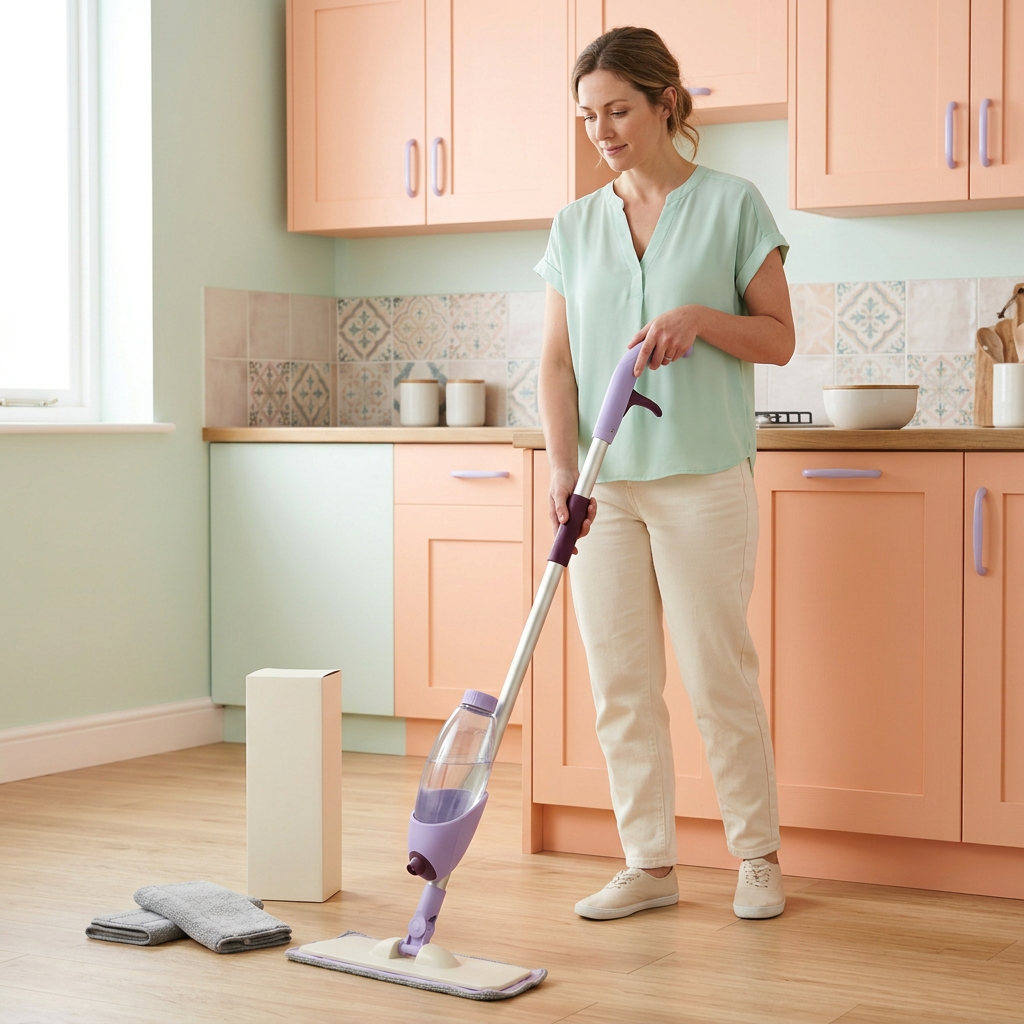
Lavender Spray Mop with Clear Reservoir, Cream Flat Head and Coordinated Gray Cleaning Pads
Lavender Spray Mop with Clear Reservoir, Cream Flat Head and Coordinated Gray Cleaning Pads
Couldn't load pickup availability

Product development draft: Generated concept imagery, not a verified production sample. Confirm spray operation, reservoir capacity, dimensions, pad composition, supplied quantities and flooring compatibility before publication.
💜 Not every floor-care moment needs to become a whole-room project
The table has been cleared, the coffee cups are back in the cupboard, and there is one little area beside the counter that needs attention. You are not planning a deep clean. You simply want the room to feel ready for whatever comes next.
This lavender spray mop concept is designed around that smaller, more focused moment. Its proposed arrangement brings a clear reservoir onto the lower shaft, above a cream rectangular head with lavender edge details and a gray fabric pad. A curved upper grip and dark plum trigger give the silhouette a distinct identity, separate from a traditional mop-and-bucket collection.
What makes this design different from the bucket set?
The difference starts with where the liquid is carried. Instead of showing a separate bucket, this concept places an oval transparent bottle in a lavender cradle on the lower portion of the handle. A small dark plum nozzle appears at the front of that assembly.
The intended manual-spray format would allow the user to apply an approved liquid near the working area. Actual spray output, trigger operation, leak resistance and acceptable liquids must be established through supplier documentation and sample testing. No spray distance, coverage pattern or measured water saving is claimed here.
Visually, the reservoir adds a useful contrast: a clear curved form against the straight silver-tone pole. The lavender screw-cap detail connects it to the handle, lower joint and head edging, making the collection read as one coordinated product.
What can you see when you look closer?
At the top, the handle curves forward into a rounded end. Beneath it, the darker trigger stands out from the softer lavender shell. A plum-colored section farther down the shaft adds another point of contrast without introducing a screen, cable or decorative control panel.
Near the floor, the bottle sits above the head rather than beside it. A lavender lower connector links the shaft to the cream rectangular platform. The gray fabric surface extends beneath that platform, creating a textured boundary between the smooth head and the floor.
These are visible design details in the concept images. They do not establish the tool's weight, grip comfort, joint durability or ability to fit under specific furniture. Those practical questions should be answered with a physical sample.
Where does a smaller cleaning session begin?
Begin with the floor, not the liquid bottle. Identify the material and finish, then check the flooring manufacturer's care instructions. A sealed surface, an unsealed surface and a moisture-sensitive joint may require very different treatment.
Remove loose debris first using a suitable method. Clear a small working area and keep people away from damp sections. If the finished tool is approved for the intended floor, follow its instructions for filling the reservoir, fitting the pad and operating the trigger.
Use only a compatible solution and avoid assuming that a stronger mixture will produce a better result. Do not mix cleaning chemicals. Excess moisture can be a problem even when the visible surface seems hard and durable, so the correct amount depends on the floor rather than on a dramatic product demonstration.
🪻 Why show more than one pad?
The proposed kit presentation pairs a fitted gray pad with two matching spare pads. Their coordinated shape and color keep the collection visually consistent while suggesting a practical rotation between use, cleaning and drying.
The actual package count, attachment system and textile composition remain to be confirmed. A textured appearance does not prove microfiber content, machine-wash compatibility, antibacterial properties or a particular reuse lifespan.
Once those details are verified, pad care should become part of the listing rather than an afterthought. Users should know how to remove the pad, which washing method is approved and how to dry it before storage. Replacement availability should also be confirmed so future purchases do not depend on a vague promise of universal fit.
Does the palette matter for a cleaning tool?
Function comes first, but visual consistency still has a place in the home. Lavender, cream, silver and gray create a quieter product palette, while peach cabinetry and mint surroundings bring color into the photography. The tool remains recognizable across wider room scenes and close-up detail views.
The packaging is intentionally plain: an ivory rectangular box without a printed logo. It does not introduce unrelated colors or oversized graphics. The focus stays on the mop, its reservoir and the matching pads.
The details to settle before this becomes a finished listing
Confirm assembled height, head width, reservoir capacity, trigger mechanism, bottle removal procedure, permitted liquids, pad quantities, care directions and approved floor finishes. Verify the production color and packaging against the final sample.
This concept does not promise sterilization, scratch-proof cleaning, instant drying, universal floor safety or a streak-free result. Its place in the collection is more specific: a coordinated manual spray-mop format intended for considered everyday touch-ups, supported by clear instructions once the real product has been checked.